



When MaShell had her second child, she had saved up all her PTO. She stayed at work until two days before giving birth and had her daughter at home. Her employer–a small reproductive clinic in Pittsburgh– didn’t offer paid leave, but MaShell figured her plan, while a little tenuous, would work.
MaShell’s partner worked at Amazon and, since it was the pandemic, had been told by MaShell’s OBGYN that he should request to work not near others so as not to risk bringing COVID back to the newborn.
That request was honored for two days, and then he was laid off.
This sent the small, growing family spinning. MaShell frantically contacted her employer and worked out a new agreement for her to return to work sooner than expected and work from home for the entire first year of her daughter's life. She’s grateful to have an employer who worked with her. In America, there is no guarantee.
After her year to work remotely was up, MaShell then had to figure out how to care for her one-year-old— her daughter refused a bottle and was still breastfeeding. Her boss agreed to let her bring her daughter into the office. Again, grateful- there’s just no guarantee.
I’m talking to MaShell as she sits in the driver's seat of her SUV, her phone on the dashboard. I can see stickers on the backseat window—telltale signs of her having a preschooler at home. She’s in the parking lot of the women’s clinic where she works, telling me how she’s trying to create flexibility for her staff in similar ways to the lifelines she was offered. “Most of the people I manage are parents,” she explains, “and I know firsthand how hard it is to balance work and family.”
MaShell talks about how balancing doesn’t just look like making the grocery list while overseeing toothbrushing and folding laundry while trying to get out the door for work, but also balancing the stress that she and her employees alike feel from the lack of support for families in our country.
“I’ve proposed a hybrid model for our work at the clinic,” she says. “Because so many parents are having trouble finding childcare and have to call off from work.” Sometimes, the parents she works with reduce their hours because they can’t find reliable care or support, meaning they are losing out on income they profoundly need.

Some of this is endemic: A chronic shortage of affordable childcare providers and the exorbitant cost of daycare in the United States. But it shows up acutely: A week ago, a huge storm hit Pittsburgh, causing widespread power outages. Schools closed, and some have yet to reopen, meaning moms had to stay home with their children– and meaning the clinic ended up short-staffed.
The gaps that are left by these absences– the women who miss work when their child is ill as well as the woman who can’t stay home when her child is ill– are so large and ubiquitous they are destabilizing communities, explains MaShell. “It's not just impacting moms or children or families,” she says, “but all of us, everywhere.”
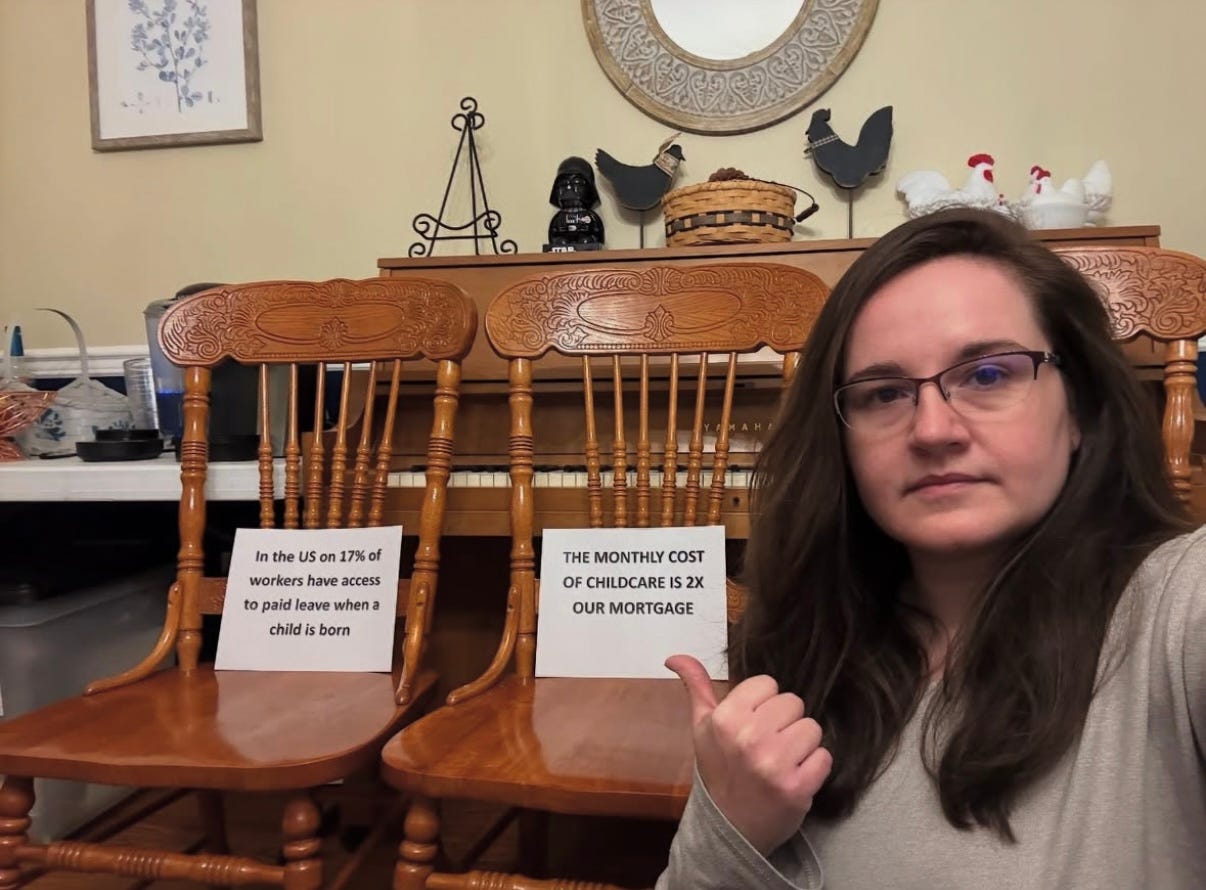
She likens it to having empty chairs everywhere– an empty chair at the dinner table when a mom has to work a late shift, an empty chair in the planning meeting when childcare fell through, an empty bleacher at the middle school basketball game because a mom took a second job, an empty desk in the office because a new mom left because the company doesn’t offer paid leave.
When she and two other moms met with legislative aides last month to ask why this new “pro-family” administration has failed to introduce any family-supporting policies in its first 100 days, they brought this imagery of empty chairs with them. “We said: Look, we would have planned for a full meeting, but there’s always moms who can’t show up because we aren't supporting them.”
MaShell’s “empty chair” analogy caught on. It was used by moms across the country as part of an April 11th action coordinated by Mother Forward in meetings with their representatives, phone banks, and social media posts.
I listen as MaShell sits in her car after a long day at work, and I think about how she helps run a women’s clinic, is a mom of two, and, with her partner, is homeschooling the children– and about how she also is making time to organize with other mother’s pushing back against those empty chairs. It feels like a lot, and I tell her so.
“Society underestimates us because we have so much on our plate,” she says about mom’s organizing. She’s helped organize advocacy days, outreach, and candidate forums around paid leave and childcare in Pittsburgh. “We do it because we have skin in the game.”
"The system has been working as it was designed to. Parents are both working, which leaves them too tired even to pay attention or have the energy to raise their voices. This is no longer an option, we cannot stand around and do nothing."
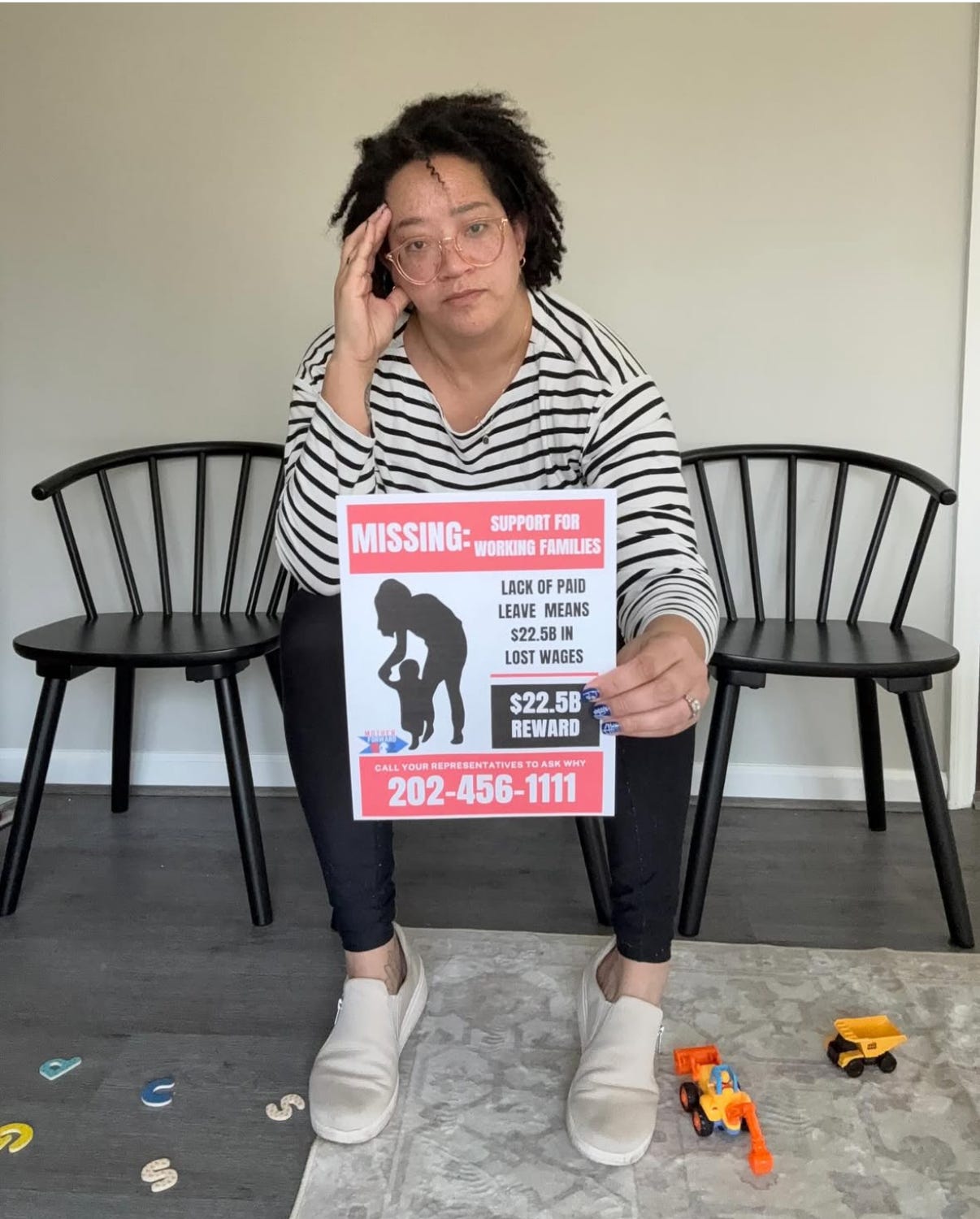
The old trope about mothers making things happen– mothers lifting the two-ton car off their child; mothers squeezing 39 hours into a 24-hour day– may have some truth to it, but it feels bittersweet. “Saying “moms can do anything” is a huge burden,” MaShell admits. “Both as a mom and a Black woman. It sucks we have to wear this as a badge of honor.”
“But as moms, not only do we already have a long list of things we already need to do, but we also are going to ask: Who is being left out?”
And the answer to that for MaShell and these moms is clear: It’s us.
“This isn’t a private issue, this is a public issue for our country to address,” she says. “Helping families helps everyone in the long run.”
👏👏💞 Amen don't tell me they're pro life either because imo they are not. Pro hustle & force one to work themselves & their families to death. All the policies that they put forth prove this to be true also while projecting the exact opposite. The real abortion party that can never deliver at least anything really meaningful in the living lives of so many only for those already profiting off of it. Empty chairs & their empty souls.
Another brilliant story that everyone should read and hear, particularly those in so-called power.