

Doing Her Part
A guest essay by Sue Granzella

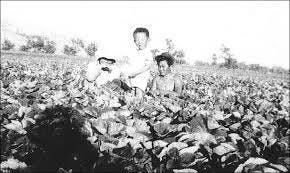
Shizue’s earliest memory is of picking strawberries with her grandmother at a sharecropping camp, alongside Japanese Americans who’d lost their farms when they were incarcerated during World War II. She was five, stooping in the swelter of California summer, plucking warm strawberries from low bushes.
When her grandmother was released from imprisonment, her former neighbors warned her. “Don’t come back here. People still hate us. They’re shooting out our windows at night. We’re sleeping in the hall.”
So she lived in someone’s basement until she found work at a sharecropping camp near San Jose, where Shizue eventually joined her. What Shizue saw there has never left her.
“They worked together in community. They all built the irrigation system out of redwood planks sealed with tar. They dug troughs and laid these things end to end down this whole field. How could they get it to slant just enough that the water was carried all the way? That sense of working together was very Japanese, and Japanese American. Everybody quietly doing their part.”
Doing her part within community—it’s how Shizue has lived ever since.
Her grandmother had immigrated in the early 1900s, and her world in America was close-knit and self-protective. Excluded from neighborhoods and institutions, the immigrants built their own communities with stores, churches, sports teams and scout troops. Everyone pitched in to make things happen.
In contrast, Shizue moved frequently until she was twelve, ping-ponging from segregated Baltimore to occupied Japan to the sharecropping camp and back around. In Baltimore, the neighbors were all Irish, Italian, or Polish Catholics. As the only Asian child in her school, she learned life lessons in these largely white environments.
“They all had their own rules,” she says, “and everyone had different rules. But I always had one or two friends, and that’s what saved my life—that ability to connect somehow and learn about the kindness of strangers.”
Desperately shy as a child, Shizue was silent unless others reached out to her.
“As I grew up,” she says, “I began to understand paying it forward. When I’d see somebody at the edge of a room, I’d go talk to them. I knew what it was like to feel like an outsider. And I was a teacher’s pet, which insulated me from the bullies, and instilled in me a love of learning and a real hunger and curiosity about all kinds of worlds.”
Shizue sensed at an early age that assigning labels—working class, Irish, Catholic, etc.--can lead to isolation, a sense of not belonging or fitting in.
“As an adult,” she says, “I realized that many people, regardless of class or color, grew up thinking that who they were was not okay, that they had to hide their true selves. I think that still divides and hurts people.”
That insight has shaped Shizue’s community work.
*
Shizue, whom I came to know in the 2010s, today works with tireless passion to address that divide between groups of people, the pain of “difference” she felt as a child, the pain of separation among the strata of humanity. Her approach is deceptively simple:
She brings people together to share their stories.
Discussing her varied work experience over the years, Shizue reflects, “I think all along there was a part of me that said, ‘I want to change society.’ I went to marches and stuff, but in terms of any hands-on real organizing, I just didn’t trust it. It can easily become a war of ideas.
“And it’s not the ideas that matter. It’s what’s being done day-to-day on the ground. I go out of my way looking for people living full lives and understanding that they matter.”
“Go[ing] out of her way” is an understatement; I’m not sure she ever stops moving. Shizue Seigel, born in 1946, founded and directs Write Now! SF Bay, which “builds multicultural community by reflecting the complex diversities among the Black, Brown, Indigenous and People of Color that comprise 60% of the Bay Area’s population.”1 Since 2015, she has hosted free writing workshops, providing “a safe, supportive space for self-identified writers of color to explore race, class, culture, gender, and identity.”
Her efforts have yielded tremendous fruit; her website lists a dizzying array of community-focused awards, grants, and books that have amplified the voices of over 500 writers and artists of color whose lived realities may have remained unknown without Shizue. She embraces writing and art from educators, healers, activists, immigrants, LGBTQ+ people, the formerly unhoused, and “just plain folks” with roots in Native America, Africa, Europe, Latin America, the Middle East and beyond.
One of Shizue’s early books reveals stories of teachers, ministers, and other regular people who stood up against the mass incarceration of Japanese Americans during WWII. During a time of crisis, ordinary people became extraordinary advocates for justice.
About the importance of hearing from “regular people,” Shizue says:
“When I read something in the paper, it means less to me than if I hear someone’s personal connection with the news. I reach out to a lot of people and ask them for their stories and perspectives. It’s my way of keeping my ear to the ground.
“The ‘news’ focuses on the quotable soundbite, the influential people, the people with titles after their names, organizations after their names. But sustainable change arises from real people. You have to talk to people on the picket line, not just listen to the leaders’ speeches.”
Driven to share stories of real people, Shizue began applying for San Francisco Arts Commission grants to publish anthologies, each with particular focus. Her first anthology presents prose, poetry and visual art by 34 contributing writers and artists exploring overlapping histories of migration, incarceration and displacement in the city’s Western Addition, a culturally rich hub for Japanese American and African American residents. The area survived the massive 1906 earthquake, but not the city’s move in the early 1970s to eradicate “blighted slums.” Old Victorians were razed, and many thousands of people of color, living together in community, were displaced.
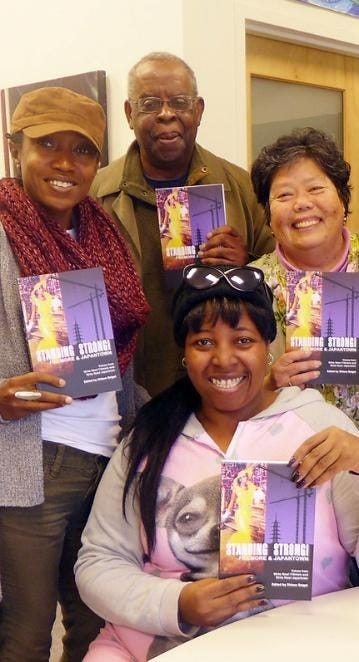
Her next anthology gave a megaphone to people of color.
“It’s hard, because a lot of people of color don’t have that sense of privilege and self-importance that ‘my story matters most.’ Instead, most of us were raised to keep our heads down, and our mouths shut.’”
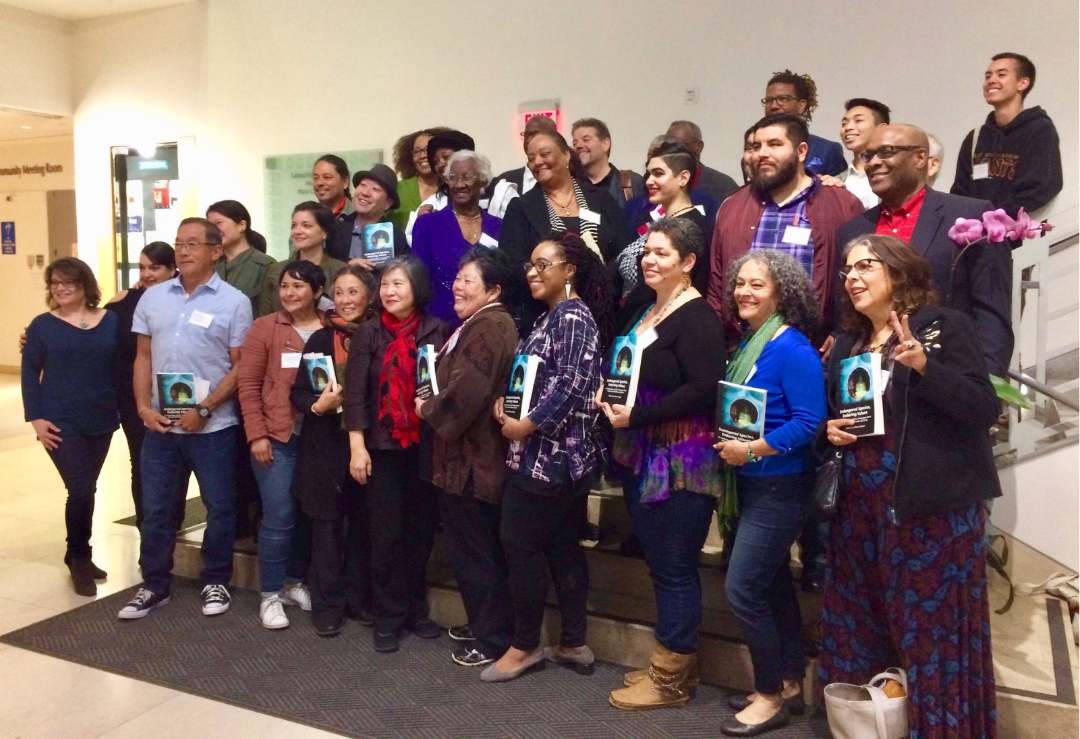
But Shizue works to convince the overlooked that their life experiences matter. Everyone benefits from a diversity of collective wisdom. Another of her anthologies focuses on civil liberties, and how violations of those liberties disproportionately affect people of color. She’s produced five anthologies so far, each emphasizing the importance of the individual parts that make up the whole.
It’s not surprising that it’s difficult to find photographs of Shizue by herself. Instead, she shows up as just one of many, surrounded by people of different races, ages, genders, cultures, and the myriad other ways that people vary on the spectrum of humanity. Shizue is always there, her brilliant smile lighting the room.
That five-year-old who picked strawberries with people imprisoned for looking like the enemy is today a poet, writer, and painter, organizing people who share stories that break down barriers and build understanding.
A note from Gwen: Sue Granzella is a writer and former long-time (32 years!) teacher living in California. I reached out to her after reading her work on The Teacher Tightrope here on Substack and just simply fell in love with her vivid and descriptive writing style. On The Teacher Tightrope she’s writing about teachers and librarians navigating the culture wars. She also talks about kids in such a clear and tender way that I have re-read a few of her pieces just to absorb again. When we connected, I learned that Sue is also publishing a book TODAY about teachers and the culture wars called Pushed to the Edge—which I just ordered myself! I hope y’all will give her a follow.
 | A guest post by
|
Thanks so much for the lovely shout-out, Gwen!